A poor reputation can dull even the grandest of occasions
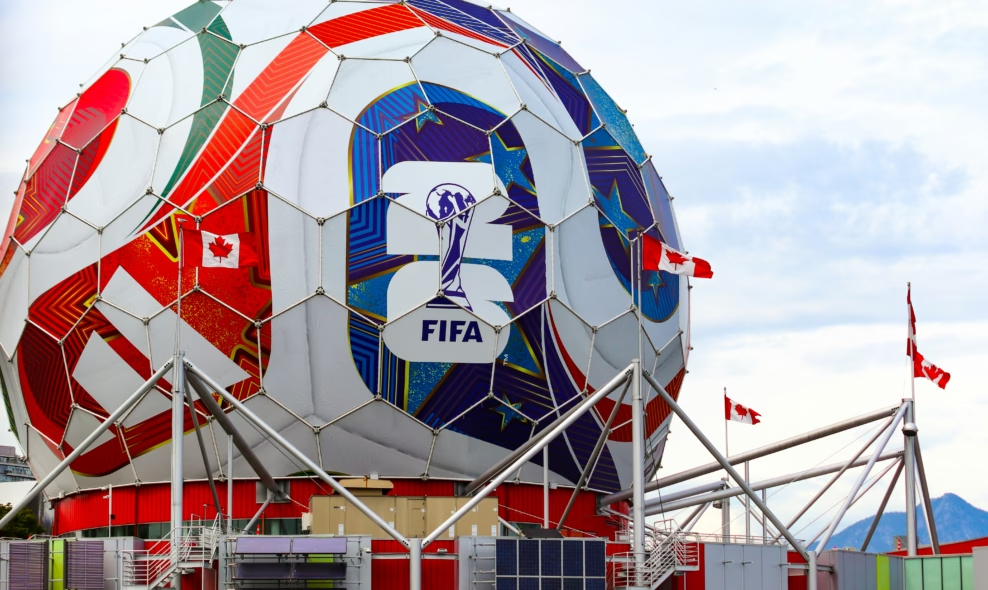

The most expensive World Cup in history has, unsurprisingly, kicked off not with a bang but a whimper. The flags on the streets are sparse, the excitement muted, and most painfully for FIFA, the stadiums are barely half full. The negativity has been building for some time, and the football, which was supposed to fix all of this, has barely muffled the criticism. So, what went wrong?
There is no single answer. Some will point to football fatigue – Arsenal played 70 games last season, and that was just one club. Others will cite the time zones. But a breakfast kick-off has never stopped a football fan from tuning in before. The real issue runs deeper, and it has FIFA’s fingerprints all over it.
This is not a governing body encountering its first reputational battering. Former FIFA President Sepp Blatter resigned in disgrace in 2015. Qatar and Russia drew years of sustained criticism before their respective tournaments began. Each time, though, the noise eventually filtered out and football ‘won’ – Messi’s World Cup victory will stand as Qatar’s lasting image, whatever came before it. What is different now is the sheer accumulation of crises happening on a nearly daily basis. The problems have been too numerous, too visible, and too self inflicted for the usual reset to kick in.
You could start with the tickets. Following a team from group stage to final has been estimated to cost between $10,000 and $35,000. Even Trump himself said he would not pay it – a remarkable statement for a tournament host to publicly make. When one recent match showed a stark gap between the announced attendance and the empty seats visible on TV, FIFA was forced to respond, claiming that the stated number of fans did attend – but they were standing in the concourse.
What they cannot hide is that fewer than half the games have sold out so far, and many of the seats that are occupied belong not to fans but to corporate sponsors on complimentary tickets. Some fans have already begun calling out the relentless celebrity camera cuts mid game – a small thing, but another sign of who this tournament is really for.
Then came the water bottle ban – so poorly received that UK Prime Minister Keir Starmer called it “wrong”, going as far to say it was transparently commercial. FIFA reversed it, but the damage was done. After this came the mandatory water breaks, which FIFA claimed was being introduced to protect players from the heat, but is being applied regardless of temperature, including in air conditioned stadiums with the roof closed. Their real function, as almost everyone predicted, is to split the game into quarters and hand broadcasters an extra ad slot. It takes direct aim at the thing football has always had over every other sport – it’s near uninterrupted momentum.
And even now that football is actually being played, FIFA cannot stop scoring own goals. Iran were told to leave the US immediately after their opening draw with New Zealand, the squad travelling from a training base in Mexico with key staff denied visas entirely. Their captain called it “a disaster”. FIFA President Gianni Infantino visited the dressing room to offer encouragement, but his appearance did little to calm the outrage. Separately, a VAR official accused of making a gesture associated with white supremacists was cleared by FIFA’s own disciplinary committee – a process that, whatever the verdict, few outside the organisation saw as reassuring.
The Reboot FIFA campaign, which launched the week before the tournament, is calling for the largest single complaint the organisation has ever received. Whether or not it lands, it reflects something many people across the globe have been feeling for years.
What FIFA’s ‘disaster class’ shows is that when a reputation is not actively managed, it eventually accumulates against you. The troubles here were not the result of one bad decision or one bad week. They are the product of years of choosing revenue over trust, and assuming that football itself was big enough to absorb whatever baggage came with it. By the time the cracks show publicly, the groundwork has usually been laid over a long time.
For any organisation, the lesson is the same. Reputation is not something that gets managed in a crisis. It is built – or eroded – through a series of good or bad decisions. FIFA’s mistake was not the water bottle ban, or the ticket pricing, or broken promises. Those were symptoms. The mistake was treating reputation as someone else’s problem, right up until it became everyone’s.
Sign up to our weekly and monthly reads
Receive our weekly roundup of the top technology and business media stories and reputational advice as well as our insightful views on topics in the communications and technology space.

 01.10.2026
Why your company’s messaging deserves more time than you think
 01.10.2026
GUEST BLOG: You are dating your interviews
 01.10.2026
The conversations that happen before the statement
 06.07.2026
CEOs should take a hint from influencers
 06.07.2026
Why the summer PR slowdown is a myth
 07.05.2026
The rise of community influence
 07.05.2026
The PR accelerants behind fast-growth companies
 11.03.2026
Five Steps to Shaping Your Reputation Strategy
 11.03.2026
Brands need to be looking beyond International Women's Day
 11.03.2026
Here's what the Inside PR 2026 Report tells us about the state of the industry
 19.01.2026
Video revived the radio star
 19.01.2026
How to truly own the narrative
 19.01.2026
Why you should never underestimate a comms professional
 17.11.2025
The Christmas ad season has arrived - and it’s telling us something important
 17.11.2025
Four shifts shaping PR in 2026
 17.11.2025
How PR in Europe really works
 15.10.2025
Smarter, safer, or just louder? How AI comms must change in 2026
 15.10.2025
Why every company needs a crisis communications handbook
 15.10.2025
How to write a PR brief that gets results in 2026
 05.09.2025
The deeply human joy of puzzles – and what it means for communicators
 21.07.2025
When AI eats itself, what’s the future of content?
 21.07.2025
Salt in the wound – When storytelling crosses a line
 21.07.2025
What we’re loving this summer for tech PRs
 13.05.2025
What a celebrity space flight taught us about PR
 13.05.2025
Generative Engine Optimisation: The PR-led discipline reshaping brand visibility
 13.05.2025
Is the future faceless leadership?
 12.02.2025
Cancelled? There’s Cover for That
 12.02.2025
The year of the uncomplicated
 22.11.2024
My first encounter with an AI hallucination
 25.10.2024
Why AI won’t be taking over from PR
 25.10.2024
Building a strong reputation in Europe – a comms checklist
 23.07.2024
Strategic PR planning – how to prepare for the summer slowdown
 22.05.2024
Is VR growing up?
 30.04.2024
Spokespeople – navigating the social media tight rope
 20.03.2024
Does cybersecurity have a comms problem?
 12.03.2024
Setting Sail: Navigating the Business Seas with Reputation
 02.03.2024
Avoiding the pitfalls of impulsive PR
 04.02.2024
From potato to progress: Addressing communication breakdowns
 02.12.2023
Realistic Resolutions that Stick
 18.10.2023
The powerful comms combo between strategy and creativity
 06.10.2023
The Rise of the Tech “LinkedInfluencer”
 08.02.2023
Is the de-influencer movement another reputational hazard?
 02.02.2023